
|

|
|


|
|
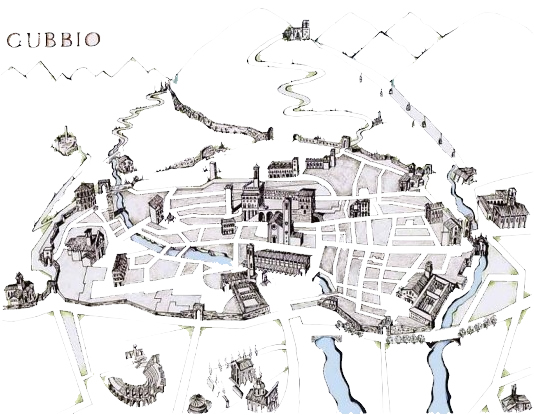
| MAP AND THE MONUMENTS OF THE CITY |  |
|
Church of St. Francis | War memorial | Sharpshooter lodge | St.Maria of Bianchi | St.Giovanni | St.Domenico
Captain of the people building | The Bargello building | Fountain and church of St.Giuliano
Consoli Building, Communal Building, Piazza Grande | Ducal Building | Duomo | St.Francis of the Peace | S.Maria Nuova
Church of Neri | Monastery and Church of St.Marziale | St.Augustine Church | Statue of St.Ubaldo | Church of St.Pietro
House of St.Ubaldo | Roman Theatre | Mausoleum | Mausoleum of the 40 Martyrs | Church of Madonna del Prato
Church of the Piaggiola | Church of the Vittorina | Church of St.Secondo | Basilica of St.Ubaldo | Church of St.Croce
Hermitage of St.Ambrogio | Medieval aqueduct
Church of St.Francis
The merit of this construction was given to friar Bevignate of Cingoli, but it isn't certain, because he is thought to have been born in 1250.
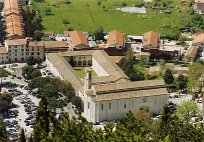
Spadalonga family was situated, the friends of Francis, who welcomed him affectionately in 1207 when he took off his clothes to leave his family and Assisi, dressing himself only with a thin overall, and refuged himself in Gubbio.
In the sacristy there are visible traces of the walls of the Spadalonga house, well conserved.
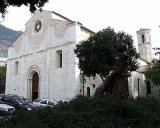 On the left side, facing the public gardens, there is an entrance door in romantic style, with two openings, one of which has been walled close, and on top there is a beautiful rose window. The facing, non completed on the upper part, presents its principal portal, in Romanic style, surmounted by a rose-window, made only in 1958. In that occasion the two windows which had been opened in 1700 on top of the door, were closed, when internally the church was transformed in baroque style.
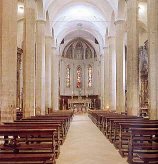
It's the only church in the city with three naves.
Internally there are 14 big octagonal stone pillars which hold up the arches which are all at the same height in all three naves.
The arches and capitals are results of the restorations of 1754.
The chapel on the right is divided by an arch of the fourteen hundreds.
In the upper part there are visible fragments of frescoes of the thirteen hundreds; under there is an arch, in the centre Christ Saviour, and on the sides the Evangelists.
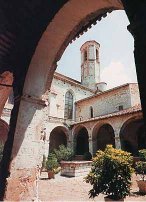
The "Cloister of the peace" is noted in the convent because of its historical and artistic value, which faces the "Capital Hall" where one time the monks met to decide on the laws of their convent life (when it no longer was used for this purpose, for many years and until some decade ago, it served as storage house for the salt of the State Monopoly, the so-called "salara"). From the "cloister of the peace" you can pass through to the "Refectory", now transformed into congress hall, and to the "major cloister", the actual and real cloister of the convent, not open to the public, only in exceptional occasions such as art meetings and classical shows.
In the space between the church and the hospital, on the border of the garden of the monks, a monument was placed in 1997 which represents St. Francis and the wolf. The work of art, of the artist Roberto Bellucci, was realized by a citizen committee with the contribution of the Commune and the antique medieval corporations such as the University of the Bricklayers, of the Smiths, of the Carpenters, of the Shoemakers, of the Tailors and the Workers Society of Mutual Help.
On the occasion of the Great Jubilee of 2000, in the church and in the Convent of St. Francis a great work of restoration and consolidation was done by the firms: Pierotti Carlo of Gubbio, Calosi del Mastio of Florence and EdilFaramelli of Gubbio, on the project of the Engineers: Marco Balducci, Roberto Regni, Roberto Radicchia and the Architects: David Pasquinelli and Raffaele De Angelis.

War Memorial for the soldiers of the Great War ()
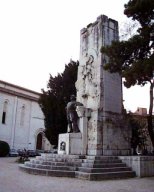 As soon as the war of ended, it was decided to build a monument in Gubbio to commemorate the soldiers who died in the Great War.
The monument, a work of the peruginian sculptor, Enrico Caianelli (), was composed of an infantryman made in bronze, leaning on the rocks, and above, a medieval tower.
It was inaugurated on the 16th May 1924, in the presence of the King of Italy, Vittorio Emanuele III.
On the 14th May 1927 the Roman Section of the Pro-Gubbio added a bronze crown onto the monument, with the inscription:
"FAR AWAY TO THE GLORIOUS DEFEATED SOLDIERS - MAY 1927"
Sharpshooter lodge
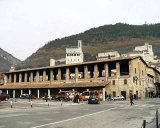 The building now indicated with this name is actually composed of two different constructions: the Church of the Bianchi with the adjacent Hospital of the Misericordia and the real Sharpshooter lodge. The Church and the Hospital, which were under the administration of the lay confraternity of the Beata Vergine Maria, belong to the beginning of the 1300s. Only in the beginning of the Six hundreds (1603) the complex was raised and the big lodge attributed to the "Sharpshooters of Pannilani" was added on; this lodge is one of the few left in Ital and the biggest and best kept. Under the lodge, in the shade, the tightly-pulled woollen materials were hung to dry after having been died in order to have determinate lengths and widths.
Its construction is proof of the strength of the "Corporation of the Art of Wool" which had created a real and proper industry famous even out of the Duchy of Urbino, of which Gubbio formed part.
Church of S.Maria dei Laici (called dei Bianchi)
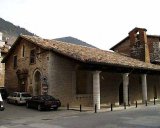 This church was built in 1313 together with the hospital called "Spedal Grande" and the adjacent lodge.
The complex belonged to the Comune of Gubbio and every Captain of the people who came in charge automatically possessed it, while the administration was in the hands of the Lay Confraternity of the Beata Vergine Maria (one of the many medieval corporations, existent in Gubbio).
One time the church was completely covered with frescoes, but in 1600 the frescoes were covered with cement. Now the church is no longer consecrated.
Church of St.Giovanni
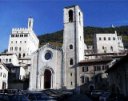
This church presumably stands in the place of an antique church which had a baptising fountain.
The construction of the actual church took place in the first half of the Two hundreds.
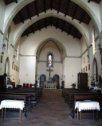
Internally it is a characteristic reason of the gothic eugubinian churches of that period, with a single nave and great ogival stone arches which hold up the roof The facing and the bell tower are in Romanic style.
Church of St.Domenico
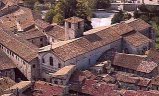 Initially the church, which was constructed in 1186, was dedicated to St.Martino, but a century later (1287) it was enlarged and dedicated to St.Domenico.
From the beginning of the Three hundreds it passed over to the Dominicans, who obtained the permission to enlarge it beyond its walls.
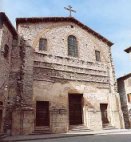 A great work of restoration, completed in 1765, gave the church its actual appearance.
It was in this transformation that many lateral chapels and many frescoes which decorated the church, went lost, and internally it took the shape of a latin cross.
Today we can admire frescoes of the eugubinian school of the '400s ( in the second chapel on the left that of Ottaviano Nelli), precious paintings and a beautiful ligneous sculpture (Madonna of the Rosary) of the early '400s. The facing remained incompleted.
The Building of the Capitan of the People
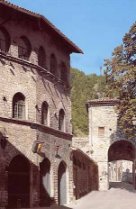 Constructed during about the half of the 1200, it was the residence of the Captain of the People, a position which belonged to the head and representative of the works which constituted the corporations and had the duty to defend them from the mayor, who could appear as defender of the nobility and middle class.
When in the second half of the 1300s the city passed under the rule of the Duchy of Urbino, the charge and office of the Captain of the People was suspended and the building was sold.
For some years the Counts Gabrielli lived there and they sold it in the year 1800. The building then became the home of different families until the eugubinian, Dante Minelli bought and restored it, bringing it back to its original antique splendour, in the first years of 1970.
The building is composed of a ground floor, with rooms open to the public; of a middle floor which was the hall of representatives; and of the last floor where the body of guards were settled, at the Captain's disposition.
The Bargello Building
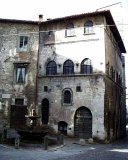 Solid, austere and small building constructed in 1302, it was the first public building. It perfectly conserves its original gothic style. Its name derives from the "Bargello" which, in the communal era, was a magistrate with police functions.
The building has an architectonical structure typical of the houses of that period : on the ground floor the big door, on ground level to enter the shop or the basement; laterally a narrow door with the opening about 80 cm high from the ground. This door communicated internally with the shop and with a steep internal stairway which leads to the top floors. To enter the door there was a wooden ladder of three steps which was taken in at night. This kind of door is today called the "Door of the dead" and this definition derives from the fact that in a certain period the habitual entrance to the houses was through the shops, because it was much easier. The small entrance door was therefore only opened in case of funerals to let the coffins pass.
Presently the Palazzo of the Bargello is the meeting place of the Balestrieri (cross-bowers) Society and the Society of the Sbandieratori (flag displayers).
Fountain and church of St.Giuliano
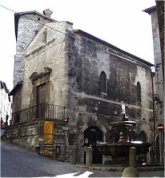 In front of the Bargello building there is a characteristic square with the Fountain of St. Giuliano at the centre, the famous "fountain of the mad people", of the 1500s, where, according to an old tradition, the tourist who runs around the fountain three times gains the eugubinian citizenship and can have the title of "mad person". In 2001 an important restoration work was executed on the fountain.
The church of St. Giuliano was built in the early 1200s, on the second door of the Umbrian belt (porta tessenaca); presently the University of the Tailors celebrates its protecting saint: St.Omobono.
The Building of the Consoli, The Building of the Podestà and Piazza Grande
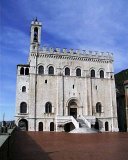 The Building of the People, later called Consoli, in the period of the free comune, was the seat of the executive power of the consuls.
The deliberations of and of imposed that the buildings should be built on a place which bordered with all 4 the quarters in order to form a centre of government which would not be inserted in any particular quarter, but touched them all. To realize this project it was necessary to fill the gap of ground between the two buildings with 4 big arches which hold up Piazza Grande.
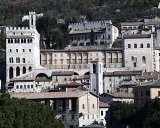 The construction of the buildings and the piazza started in 1332; in only four years' time the main entrance door of Palazzo dei Consoli was put up; in 1338 the Palazzo dei Consoli was inaugurated.
The construction works of the Building of the Podestà were interrupted in 1350 due to the temporary command of Giovanni Gabrielli.
The construction of the whole architectonical complex is attributed to the famous eugubinian architect, Matteo di Giovannello, also called Gattapone; while the main door of the Palazzo dei Consoli and the two side windows are attributed to Angelo of Orvieto.
.jpg) The big stairs lead to the great "Salone dell'Arengo", a huge room, covered by a single barrel-shaped arch which takes up almost all the space of this floor: during the period of the free comune all the heads of the families in Gubbio met here before taking any important decisions.
The big stairs lead to the great "Salone dell'Arengo", a huge room, covered by a single barrel-shaped arch which takes up almost all the space of this floor: during the period of the free comune all the heads of the families in Gubbio met here before taking any important decisions.
Presently in this hall there is an Archaeological Collection; in the adjacent rooms the famous Eugubinian Plates (Tavole Eugubine) are kept and a collection of medieval coins of the mint of Gubbio and other mints of Central Italy. The city of Gubbio in fact had a famous mint from 1400 to 1830.
In the halls of the upper floor there is an interesting Picture Gallery with works of mostly Umbrian schools, from XIII and XVIII century.
On the sides of the roof the edging and the bell tower, which reaches the height of 52 m from the ground with its Giant Bell (Campanone), of 21 quintals of bronze, melted in 1769, and reminds us of the voice of the Free Comune of Gubbio.
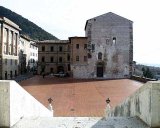 The Building of the Podestà, the present seat of the Comune and of the Mayor, occupies the oriental side of the piazza. This building was also constructed by Gattapone, but was left incompleted. It probably should have had the same height and the same edging as the Palazzo dei Consoli. Along the corners of the building facing the piazza there are clear signs of an abrupt interruption of the work (1350) in the period when the democratic comune left the way free to the country squire, Giovanni Gabrielli who became the master of Gubbio overnight.
This Building which originally was composed of two different structures, was ampliated in the future centuries, in fact the construction in bricks on the left side of the building dates back to the end of 1600.
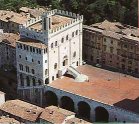
The building standard used in the construction was bold and exceptional: a single central column on which great arches lean, which join onto the perimetral walls and hold up the weight of the arches and the ceilings.
The Ducal Building
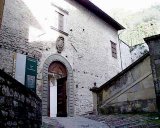
The Ducal Building. It was built on the request of the Duca Federico of Montefeltro in the years immediately following 1470.
The Building was probably projected by the Dalmatian architect Francesco Laurana, but was completed by Francesco Di Giorgio Martini of Siena.
It has many similarities with the corresponding ducal building of Urbino.
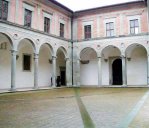 The Building is composed of two structures joined with a beautiful courtyard, with a blind wall which covers the medieval remains of the Tower Corte Longobarda and the old Comunal Building.
Inside there are works of great artists, but unfortunately when the Montefeltro and Della Rovere families (their female successors) were in extinct, the building was sold to private people who sold everything they could possibly sell. In this way doors, windows, chimneys and even bricks of the floor are spread out in all museums of the world. The famous and beautiful study of the Duke Federico, hand-made by the best artists of that period now is in the Metropolitan Museum of New York.
The Duomo
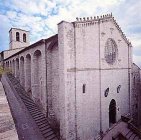 The present Cathedral was built in the last twenty years of 1100, in fact in about 1190 the priests of San Mariano obtained the permission to transfer the remains of the Eugubinian Martyr Saints: Giacomo and Mariano, to this church.
This church underwent important modifications and amplifications.
In the beginning of the 1300 the facing which allows you to see the facing of an antique church on the right, was constructed, in Romanic style, which probably reminds us of the primitive complex of the duomo.
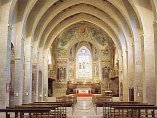
The inside, in the shape of the latin cross, is characterized by a single great nave, with ten ogival arches which hold up the roof with double eaves.
The works of Benedetto Nucci and his son Virginio (), Dono Doni, Antonio Gherardi, are kept here, and the exceptional work of inlaying of the eugubinians L. and Giacomo Maffei are also kept here.
.jpg)
.jpg)
In the Duomo there are many tombs of various Bishops, Blessed persons and saints: Pietro Gabrielli () and Gabriele Gabrielli (), Beato Forte Gabrielli (), St.Giovanni of Lodi (), Beato Villano, bishop of Gubbio from 1206 to 1240 and friend of St.Francis to the extent of asking him permission in 1213 to build a small convent at the Church of the Vittorina, place where St.Francis met the wolf.
The Museum of the Duomo is situated in the adjacent Building of the Canonici of the Cathedral, and it conserves apart from numerous works in stone of roman and medieval period, also paintings of the 1200, 1300 and 1400. On the ground floor there is also the "Barrel of the Church", an exceptional work of art of the 1500, built without iron rings, and can hold 387 "Barrels" of wine (about 200 hectolitres).
St.Francis of the peace (called "of the Bricklayers")
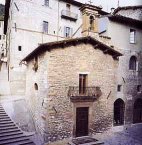 The church was built in 1608 and belongs to the antique corporation called the "University of the Bricklayers".
According to the tradition, the church was built on the place where the wolf which St.Francis tamed, lived until its death.
In 1871, not far from the church, in Via Savelli della Porta, while they were constructing the niche at the Crocifisso, the skeleton of a wolf was found, and was buried in this church.
In this church many things remind us of the meeting of St. Francis and the wolf: the small bas-relief, representing the wolf on the architrave of the door; the altar built of the stone on which St. Francis stood on while he met the wolf; the statue of papier machè behind the altar, which represents the Saint with the wolf while they made their pact.
St.Maria Nuova
The Church of the Neri
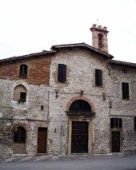 This baroccan church is also called the Church of St. Giovanni Decollato. The Family of the Santantoniari are now in charge of this church where they celebrate the festa of St.Antonio Abate and the investiture of the Capodieci of St.Antonio.
On the 15th May the statue of St. Ubaldo, which is carried through Gubbio during the procession, immediately before the Corsa of the Ceri, is stopped in the church. The statue is taken back to the cathedral the next day at ten o'clock.
Until about 20 years ago the statue was taken to the Duomo straight away, while the race of the Ceri was on!
Monastery and church of San Marziale
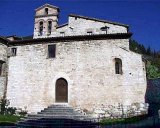 The church of the monastery was once called St. Andrea, the name of which was derived from one of the quarters of the city. According to some people (Don Antonio Menghini, 1820)" the church of St.Andrea was once the temple of Mars, and this explains its present name.
Its construction dates back to the year 1000, and therefore is the oldest antique holy building within the walls of the city.
Internally it is simple and majestic with two naves. Across there is the Porta Vehia, which belongs to the walls of Umbrian period (today called: the Arch of San Marziale) dated back to the IV - III century b.C.
Church and convent of St.Augustine
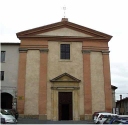 The construction of this complex started in 1249 on the ground which had been donated from the Comune.
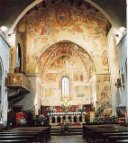 The church has only one internal nave and a structure of cross-archways which hold up the roof and which are similar to those of other eugubinian churches of that period; the facing was redone in bricks in 1790 and does not have any particular characteristics.
On the inside there are frescoes of Ottaviano Nelli, as "Storie di S. Agostino" (1422) and the "Giudizio Universale" (1424-27), discovered in 1902 when the plastering which covered them, was removed.
Statue of St.Ubaldo
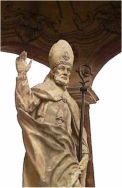 This work which stands at the beginning of Corso Garibaldi, is not very antique. It was made with public and private money in 1774. The idea of putting there a statue of the patron saint came from the yielding of the existent wall. The project was encouraged by the fact that it was the sixth centenary of St.Ubaldo, in 1760.
But it was impossible to make this dream come true because of the lack of finances in that period: for some time a wooden statue was put there, but in 1774 all this came to an end!
Unfortunately the artists who made the statue are unknown.
The Statue and the whole news-stand was restored in 1999, thanks to the Family of Sangiorgiari who formed a citizen committee composed also of the other civil, religious and ceraioli groups (Family of Santubaldari, Family of Santantoniari, University of Brick-layers, Association of Maggio Eugubino).
Thanks to the public and private offers collected by the committee, the statue was restored perfectly by local expert craftsmen. The voluntary participation of the eugubinians who helped was great. For this occasion a new electrical illumination system was installed.
Monastery and church of St.Pietro
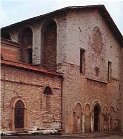 The exact foundation date of this church is unknown but in the full medieval period this church, after the Cathedral, was the main religious eugubinian building.
The facing of the church presents traces of three different periods.
The columns of the portical which one time decorated the facing (VIII - IX sec.) belong to the first period, but are now englobed in the wall; the superior part of the facing is of the 1200, while the two rectangular windows are of the end of the 1500.
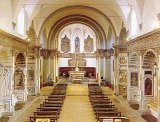
.jpg) In 1200 the three naves on the inside were reduced to one with the roof held up by seven arches as in the other eugubinian churches of that period.
In 1200 the three naves on the inside were reduced to one with the roof held up by seven arches as in the other eugubinian churches of that period.
In 1505 after the Benedictines, the Olivetans took over, and transformed the old church and the internal part of it, where there are various works of art and a beautiful carved organ, made by Antonio and Giovanni Maffei.
House of St.Ubaldo
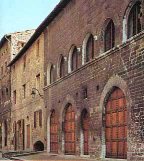
It is a beautiful classy characteristical eugubinian house, the facing of which is of the 1300: the original house was further on, halfway along the road, and maybe it was destroyed to make space for the construction of the Palazzo dei Consoli.
It is therefore possible that the house was built before the 1300s, but not before the big fire of 1126.
The fact that it belonged to the Baldassini family explains the tradition which believes that it is the birth home of St.Ubaldo, even if he was born in 1085.
The Roman Theatre
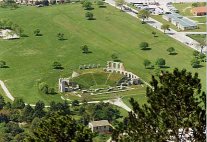
It was constructed in the last period of the republican Rome, maybe during the Civil War, between Cesare and Pompeo, that is in the half of the first century b.C..
It was restored and amplified by Gneo Satrio Rufo, governor of Gubbio during the Empire of Augusto (31 b.C. - 14 a.C.).
The arches, pillars and steps of the cavea remain.
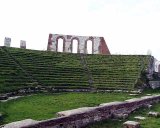
It was one of the biggest theatres of the roman world (the biggest was only the Marcello theatre of Rome): the part reserved for the public, the "cavea", of which only 22 steps are left, has a diameter of 70 metres and could hold about six thousand spectators.
The "Cavea" was in fact very much higher than the actual one, and leaned on two rows of arches, but there is practically nothing left of the superior part.
The first damage done to the theatre was in 772 during the occupation of the Longobards, lead by King Desiderio. But the biggest damage was done during the late medieval period when the theatre was considered a stone quarry for the construction of a new Gubbio.
Nevertheless, today, during the summer period, important theatre plays, especially of antique Greek Latin theatre, are represented in this roman theatre.
Mausoleum
 According to the Latin storical Tito Livio, this construction is the tomb of Genzio, king of Illiria, ( western part of the Balkanic peninsula), who after being taken prisoner by the Romans, in 168 b.C. was kept prisoner in Gubbio and died and was buried here.
According to others it should be the tomb of a certain Lucio Pomponio Grecino, son of a roman consul.
It is 9 metres high, the external was covered in stone and in the medieval period was removed and used for the construction of some building. The internal part is well kept, even if it lost its marble plates; there is a barrel shaped arch, illuminated by a small window on top of the door.
Mausoleum of the Forty Martyrs
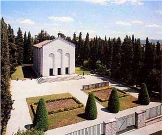
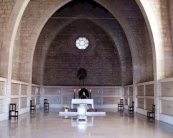 It is a building in the shape of a chapel built by the commitee "pro forty martyrs", on the project of the Architect Pietro Frenguelli of Perugia, on the place where 40 innocent hostages were shot by nazist troops on the 22nd June 1944, for retaliation after an operation of the partisans.
Their names, their age:
|
Allegrucci Giuseppe, years 34
Baldelli Carlo, years 34 Baldoni Virgilio, years 38 Bartolini Sante, years 55 Battaglini Enea, years 20 Bedini Ferdinando, years 39 Bedini Francesco, years 50 Bellucci ubaldo, years 34 Cacciamani Cesare, years 52 Cacciamani Enrico, years 50 Cacciamani Giuseppe, years 19 Farabi Gino, years 39 Felizianetti Alberto, years 23 Gaggioli Francesco, years 17 Ghigi Miranda, years 30 Ghigi Zelinda, years 61 Lisarelli Alessandro, years 23 Marchegiani Raffaele, years 57 Mariotti Ubaldo, years 18 Migliarini Innocenzo, years 40 |
Minelli Guerrino, years 27
Minelli Luigi, years 42 Moretti Franco, years 21 Moretti Luigi, years 22 Pannacci Gustavo, years 36 Paoletti Marino, years 30 Piccotti Antilio, years 41 Pierotti Francesco, years 40 Profili Guido, years 54 Rampini Raffaele, years 43 Rogari Nazzareno, years 50 Romanelli Gastone, years 17 Roncigli Vittorio, years 38 Roselli Luciano, years 23 Rossi Domenico, years 41 Rossi Francesco, years 49 Scarabotta Enrico, years 36 Sollevanti Giacomo,years 18 Tomarelli Luigi, years 61 Zizolfi Giovanni , years 23 |
Madonna of Prato Church
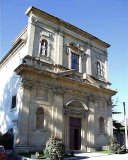
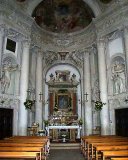
An elegant church in baroque style built by the bishop of Gubbio Alessandro Sperelli () in the second half of the XIIth century.
It has a plan in the shape of the greek cross, with a beautiful central dome decorated with a huge fresco of F.Allegrini.
Church of the Piaggiola
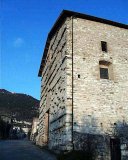
Dedicated to St. Mary of the Piaggiola, built in 1624, and is the last public work realized in Gubbio before the city passed from the duchy of Urbino to the Church State (1631).
Even though the facing is not completed, the inside of the church is very interesting and is the best example of baroque art in Gubbio.
Presently the church is not open to prayer.
Church of the Vittorina
In fact tradition wants that in this place, in about the year 1220 St. Francis met and tamed the wolf which killed people and animals.
St.Francis had the permission from the bishop of Gubbio: Beato Villano, in 1213, to use the Church of the Vittorina for the investiture of the Franciscan monks, who moved to the Convent of St.Francis some decenaries later (1241).
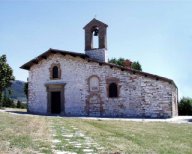 The present church was built in 1200, but the original part is only the apse with the small romanic window. In fact, towards the half of the 1500 the church underwent a notable transformation and it was in this period that most of the frescoes in the church were painted by Virgilio Nucci.
Today the construction is in a shed shape, built mostly in stone with clay inserts. It is evidently the simplicity of the building which gathers the places of prayer into a single volume, one time destined to religious persons.
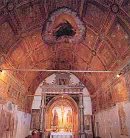
On the inside there is a single nave with a rectangular plan.
On the right of the entrance there is a chapel, a sacristy and a passage to the upper floor.
Presently the church is surrounded by a park with olive trees and other plants planted in the early 90s.

A bronze bas-relief monument which illustrates the meeting between St.Francis and the wolf, was put in front of the church in 1973.
The work of art was made by the sculptor Farpi Vignoli of Bologna, on commission of the Maggio Eugubino Association.
To remember that St.Francis was the "inventor" of the first "presepe" (at Greggio - Rieti - at Christmas 1223), from Christmas of 1988 the Presepe of the Vittorina is made in the park which surrounds the church to celebrate the Birth of Christ as the saint taught us and in a place which is the most important of the franciscanism. This "presepe" is put together annually by the voluntary workers of the Cultural Association of St.Francis and the wolf.
In the year 1999 the church underwent an important restoration, thanks to the firm Air Liquide Italia, to fix the damages caused by the earthquakes of the previous twenty years.
An other bronze statue which illustrates the meeting between St.Francis and the wolf was inaugurated near the church on 7th April 2002. The work of art was made by the sculptor Francesco Scalici
Church of St.Secondo
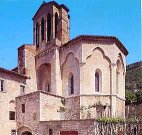 The church and the convent of St. Secondo form a monumental complex which we are aware of since the XII century.
The cloister belongs to this period, for its construction columns from antique buildings were used.
In this parish the young Ubaldo Baldassini (St.Ubaldo) received his first schooling round about the year 1100.
The present church is the result of continuous restorations, but it still has various architectural elements which are witness of its long life, such as the apse which represents a splendid example of eugubinian gothic in 1200.
The altar, even this gothic, was made in 1336.
Basilica of St.Ubaldo
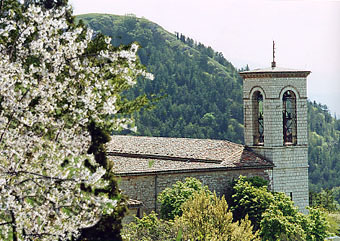 The Basilica occupies the place of an antique little church, dedicated to St. Gervasio. It became the church of St.Ubaldo when on the 11th September 1194 the eugubinians transported his body.
In the following centuries the church was restored and amplified in different occasions. In 1514 the duchesses of Urbino, Elisabetta and Eleonora Della Rovere, neices of Pope Giulio II, rebuilt and enlarged the church: the cloister was built, the inside was built in three naves, the convent became of its present size. In the second half of the 1800 the marble altar was restored and the golden bronze urn was built in 1886, which contains the body of St. Ubaldo, on the order of the Count Carlo della Porta. This urn was restored in 1996 by the "Family of the Santubaldari", with public and private contributions, by the Prof. Francesco Scalici, teacher of the Statal Art Institute of Gubbio.
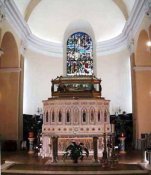 From 1916 to 1922 thanks to the insistent actions of Padre Emidio, the franciscan rector of the Sanctuary there was a big restoration and enlargement of the church. The generosity of many eugubinians, with that of the bishop Nasalli Rocca and the Pope Benedetto XV, allowed the naves to increase from three to five, and allowed the construction of a new bell tower (1919) replacing the old falling one and which was put at the opposite end of the church. Even the altar was adapted to carry the urn of the Saint and all around it a gate was built which was removed in 1980 when the altar was moved, from its position under the dome, towards the apse in order to enlarge the central nave.
The church became "Basilica" in 1919 as Pope Benedetto desired in XV.
In 1920 the basilica was furnished with a new organ, made by the firm Morettini of Perugia, today still working.
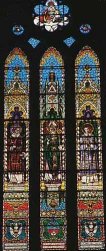
Two years later L. Mosmeyer of Florence made the glass windows which represent the main episodes in the life of the Saint.
Today a committee for the Basilica of St. Ubaldo exists which takes care of improving the conditions of the Basilica. The comunity of franciscans present in the convent, guided by Father Igino Gagliardoni, published the bimestral periodical called "Santuario di St.Ubaldo".
In this period there are still restoration works in the convent especially.
Church of Santa Croce della Foce
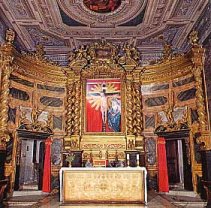 A small church with a facing of the 1600, but the first construction dates back to more antique times, in fact on a stone behind the wall of the sacristy there is a writing in roman numbers dating back to 1262.
It is from this that the Procession of Dead Christ takes place every Holy Friday, and is still organized today, as in the medieval period, by the Venerabile Confraternita di Santa Croce.
On the inside, apart from the statue of Madonna Addolorata, there is a big cross from which the body of Christ is taken off, a work of art of the eugubinian craftsmen in 1600, to be taken in procession.
The beautiful ceiling is characteristic of this church because it is made of golden squares.
Hermitage of St.Ambrogio
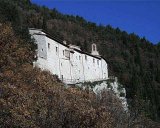 It was built in 1331, on order of the bishop Pietro Gabrielli who wanted to accept all the hermits who lived as vagabonds in the various areas around Gubbio.
In the church of the hermits, under the altar the body of the Blessed Arcangelo Canetoli () is conserved, because he lived and died here. During his presence the monastery was the continuous destination of multitudes of believers, attracted by the fame of this man.
The reason for dedicating this church to St. Ambrogio is that at a certain point of his story, after being under the Agustinians, he passed to the "Congregation of St.Ambrogiu".
During the 1900 the hermitage became abandoned but thanks to the help of the Committee for the valorisation of the Gola of Bottaccione it was possible to realize a great restoration work, concluded in 2000, on the project of the Architect Francesco Riccardini and the Engineer Giancarlo Signoretti and the execution of the work on behalf of the "Cooperativa Edile Eugubina".
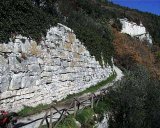
Near the hermitage we find the so-called "cyclopean walls", 50 metres long and 5 metres high, made of huge stones of 3 metres X 2. They probably represent the remains of a defence structure built by our great grandparents.
Medieval Aqueduct ("Condotto")
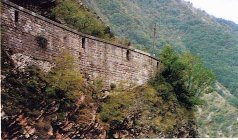 It represents the hydraulic connection system between the dyke called "Bottaccione" and the Cassero (fortified area near the mountain side of the Palazzo Ducale), allowing even the high part of the city to have tap water.
It was built at the end of 1300, it is long two km and is a great example of hydraulic engineering.
The channel to have running water was realized, thanks to hammer and chisel, between stones put tightly together.
Even the "Condotto", and Bottaccione were attributed to Gattapone, but there is no proof of this.